L Studio Netgirl Enterprises Web Design Netgirl Enterprises Web Design
History of Corral de Tierra Location of Corral de Tierra Community of Corral de Tierra Contact Corral de Tierra
 

S T E I N B E C K ’ S   P A S T U R E S  O F  H E A V E N


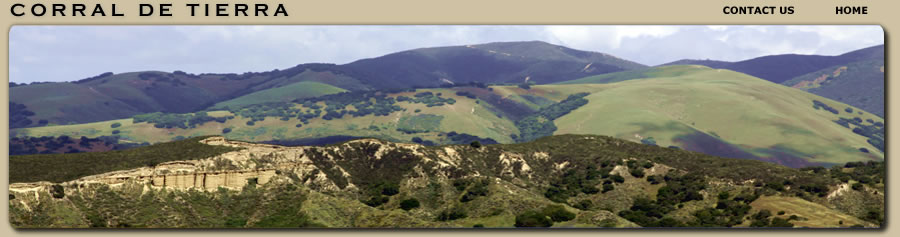
“. . . he saw—a long valley floored with green pasturage on which a herd of deer browsed. Perfect live oaks in the meadow of the lovely place, and the hills hugged it jealously against the fog and wind.”
John Steinbeck,
The Pastures of Heaven


In their youth, John Steinbeck and his sister, Mary, played at the base of Castle Rock, the “fence of earth” giving Corral de Tierra its Spanish name. The beautiful valley between Monterey and Salinas, granted by Governor Guiterrez to Francisco Figueroa in 1836, inspired Steinbeck’s short stories and California-based novels. In the last half century, small neighborhoods have been built in the valleys running off the Monterey-Salinas Highway, and a sense of independent identity and community has formed among the residents in the community of Corral de Tierra, California 93908.


History of Corral de Tierra
C O A S T A L G R O W E R
| W I N T E R ’ 0 6
BY BURTON ANDERSON, IN COOPERATION WITH THE MONTEREY COUNTY HISTORICAL SOCIETY

The first person, other than the native Indians, to wander into what is now Corral de Tierra Valley was an unnamed Spanish Corporal in 1776. He had been sent in pursuit of some Rumsen Indians who had escaped from the San Carlos Mission. In his quest he came upon the valley. In John Steinbeck’s book, The Pastures of Heaven, the Corporal is quoted as exclaiming, "Holy Mother, here are the green Pastures of Heaven to which our lord leadeth us." Whether or not this is true, it adequately describes the valley.

The next mention of the area occurred November 19, 1794 when George Vancouver, during an inland excursion from San Carlos Mission, explored the nearby hills and came across, "the most extraordinary mountain that I had ever beheld. It presented the appearance of a sumptuous edifice fallen into decay" (a reference to Castle Rock). J. Sykes, Vancouver’s accompanying artist, sketched the formation and it appears in Vancouver’s book, The Voyage of Discovery around the World, 1794. (The origin of the name "Castle Rock" is obscure, since noted historian, Paul P. Parker, Editor and Publisher of the Salinas Index Journal, did not know how the formation acquired the name.)

During the Mexican Rancho era the rancheros periodically used a box canyon in the upper valley to hold some of their livestock. No trace of the corral remains today except that the present district carries on the name. The valley remained a wilderness until April 10, 1836 when Nicolas Gutierrez granted one league (4,434 acres) to Francisco Figueroa for his daughter Guadalupe. The rancho was bordered on the south by the Los Laurelos grant in 1844.

The U.S. Lands Commission finally granted the Corral de Tierra to Henry D. McCobb on January 21, 1876. The rancho lay, for the most part, outside the boundaries of the valley that bears its name, except for Calera Canyon, at its center. Closely entwined with the history of Corral de Tierra is the Rancho El Toro (5,668 acres) within which the part of the present-day Markham Ranch is situated. El Toro was granted to Jose Ramon Estrada in 1835 and patented to Charles Wolters in 1862.

Over the years the name Corral de Tierra has expanded to include the Toro and San Benancio areas. It wasn’t until California was ceded to the United States that homesteaders moved into the valley. A large portion of the valley remained public land until the 1860s. When the public lands were opened, squatters moved into the area and occupied public land and railroad land. (The Central Pacific Railroad was granted alternate sections of public land as compensation for the construction of the first continental railroad.)

In an interview with Roy Diaz, he related that his grandfather Francisco Ambrosia, a Portuguese whaler, settled in the San Benancio Canyon area in the 1850s. Also, the Maggetti family was in the area at that time. Since San Benancio Canyon, for the most part, was not part of the rancho grants, the land was free to squatters.

The descendants of these two families still own land in the area. Perhaps the first settler in Corral de Tierra was Benjamin Titus and his family. Benjamin was away working at a railroad job in San Jose when his wife acquired the squatter’s rights to 160 acres in Corral de Tierra from George Bee. Benjamin settled on the land upon his return to Monterey County in 1869. Benjamin had nine children and eventually owned 2,300 acres that were managed by his two sons, Ben and Tom. He contributed generously to the establishment of Washington School.

From his cultivated land of 300 acres he sold vegetables and fruit in Monterey. In honor of the Titus family, a recreation area in San Benancio Canyon is named Titus Park. Thomas Watson, after whom Watson Creek is named, owned land in Corral de Tierra in the 1860s. He was a prominent citizen, serving as Monterey County Sheriff from 1863 to 1871 and donating land for the Washington School. Fred Watson Nason, Sr. was a grandson of Thomas Watson and the son of Capt. Fred Porter Nason, who settled in Corral de Tierra in the 1880s.

In 1871, Albert J .Bramers bought 700 acres from various squatters and railroad land. He built his ranch house the following year in the upper Corral de Tierra Valley. Later, he bought an additional 500 acres from Andrew Molera and Thomas Watson. The original house is still standing and is used by the family.

One could ask how he made a living in that area, but a crop that could be successfully grown was wheat. The wheat grown in the lower Salinas Valley was prone to rust; the wheat grown in the warmer climate of Corral de Tierra fetched a premium with flour millers.

Bramers also had cattle, grew barley and oats and planted a vineyard, selling the grapes in Monterey for wine-making. He contributed to the building of Washington School and served as a Trustee for 17 years. Charles Underwood’s father, Pio Pico, was the last Mexican governor of California. In 1843 he lived in the Underwood-Brown adobe near Colton Hall. When Charles died in 1923, the house was sold to the City of Monterey according to Charles’s wishes. Since 1934 it has been part of the City office complex. Charles’ son Alexander R. Underwood was born February 23, 1862 on the Tularcitos Land Grant on the Chupinos ranch, owned by his father.

Charles sold the Tularcitos and purchased 2,000-plus acres in Corral de Tierra, in the area of today’s Underwood Road. Alexander managed his father’s ranch until 1891 when ill health forced him to leave. The Underwoods were an important part of the history of Corral de Tierra.

Another pioneer family was the Leibbrandts who settled in the Washington School district in 1897. David Liebbrandt built his home on 290 acres and raised cattle, grain and had 15 acres of peaches and apples. David Libbrandt was a Trustee of Washington School. The original ranch house is still standing and I remember accompanying my grandmother and mother to buy peaches from Mrs. Leibbrandt in the early 1930s.

William Hatton settled in the Corral de Tierra land grant after moving from his dairy at the head of Carmel Valley. His old home sits on the approximate site of the original Corral de Tierra adobe in Calera Canyon. His father supplied milk, cream and butter to the Del Monte Hotel from his dairy at the mouth of the Carmel River.

There were two schools in the Valley. Washington, at about mid-valley, was established in 1873, and by 1880 had 116 students. The other school was Lincoln School at approximately the intersection of Underwood and Corral de Tierra road built in 1887. It survived for years but was recently torn down.

As time passed and the original land owners passed on or otherwise sold their land , a series of wealthy men bought up the old homesteads. Among them were Andrew Molera, David Jacks and Tom Work. In 1913, C.N. Thorup, a realtor, reacting to the possibility of oil in the Corral de Tierra area, leased 1,403 acres from the Titus and Bramers families to explore that possibility. There is no record of any economically feasible amount ever being found and the leases were allowed to expire.

Thomas R. Whitcher homesteaded on what is now the Markham Ranch in approximately 1873. Part of his original wood frame dwelling is still standing and is preserved on private property. Mrs. Margaret McNeary came to the ranch in 1926 when her father was foreman for T.A. Work and recalled that most of the buildings were intact but in a state of disrepair.

In the previous 50 years, ownership was held by David Jacks and Andrew Molera. The McNearys left in1937 and the house remained empty. Walter Markham purchased 653 acres of the homestead in 1938 and established a herd of premium Hereford cattle and also raised race horses. Gene Roland managed the ranch for 40 years for Markham and a road is named after him on the ranch.

The Markham Ranch was sold to Salvatore Palma in 1978 and later to Castlerock Estates, the company that subdivided this beautiful property. Groundbreaking for the subdivision occurred February 13, 1986. The first Post Office in Corral de Tierra was on Watson Creek near the old Lincoln School and opened May 6, 1912. Its first postmaster was Mrs. Rose A. Lambert, who later moved to Jamesburg and became Postmaster there.

In 1916, the Corral de Tierra Post Office was moved one mile west and again in 1929 it was moved two miles north. The last location was approximately near the sign over the entry to “Home on the Range.” The Post Office was closed on May 29, 1931. At the time, Mrs. Bessie Bell McCoy was Postmaster.

In the case of El Toro Rancho, after the death of Carlos Wolters, his widow leased the property first to William Powell and then M.H. Harkins before selling it to land baron David Jacks in 1880. Jacks kept the ranch intact until just before his death in 1909 when it was sold in large parcels.

Development was slow in Corral de Terra until 1959 when the founders of the Corral de Tierra Country Club purchased 120 acres from W.B. Grainger and built the clubhouse and golf course. Homer Hayward was the Club’s first president. This spurred a rush to build homes in the area. That sale and a sale by the Ferrini family of their property along the west side of Highway 68 caused a rash of development in Toro Park, San Benancio, and Corral de Tierra. These early developments soon led to approval by Monterey County of the Coral de Tierra Oaks subdivision on April 28, 1965.

Alan Pattee and the Robley family also owned considerable acreage in Corral de Tierra and it was subdivided into upscale estate lots. In the 1960s the Chamisal Country Club was developed and the area has continued to grow.

There are now approximately 13,500 residents in the Toro Park, San Benancio and Corral de Tierra districts. A few years ago there was a move afoot to re-establish a Post Office in Corral de Tierra, but for various reasons the Post Office Department turned down the request. However, they did allow residents of the area to list their addresses as Corral de Tierra, CA 93908.

Perhaps within a few years the request will be re-considered. It would certainly mean fewer road trips to Salinas on Highway 68. Meanwhile, the allure of living in the “Pastures of Heaven” remains inviting.

DOWNLOAD AND PRINT THE COMPLETE ARTICLE


7 Corral De Tierra Road ~ Corral De Tierra, CA 93908 ~ 831.484.8100
info@corraldetierra.com